Showing posts with label organic gardening. Show all posts
Showing posts with label organic gardening. Show all posts
0-2 weeks to last frost(!) - Some tips on early spring planting
As is fairly normal for this time of year, we've had a rollercoaster of weather the past two weeks. When the temperature dropped into the forties with rain, most of my plants came back inside for an extended break, and I bunkered up as well.

Inside the hoop house, spring plants loved it though. They didn't get the rain, but the cool, grey days were perfect for spinach, salad greens and peas. This week I had to start adding support to the indoor peas, while their outdoor counterparts are all of an inch high.

But the pendulum swung back the other way this week, we're at nearly 70 degrees as I write. I semi-opened up the hoop this week--rolled up the sides and took out a few side panels that were getting in the way of my snap peas. For the most part, the plants inside now are tolerant to light frosts, and are less happy when the temperature climbs to 100+ degrees. Also, with the sides up I can install my gutters and take advantage of that rain!
Last week I was talking to a woman who works with local farmers, and she was saying that the window of opportunity for spring planting was frustratingly small this year. We'd have a couple of nice days, then lots of rain, and they couldn't get their tractors into the fields. It made me realize that home gardeners have an advantage for sneaking in early crops. Still, dealing with wet soil can be an issue. I have a couple of tricks:
1. Prep beds in the fall. I turn my compost piles in the fall, and give all available beds a nice layer of compost and a mulch of leaves. For beds that will have bedding plants, I don't have to do anything in the spring--just move some mulch out of the way, and plant. This is great for broccoli/cabbage and onions, who are often ready to plant when the weather is wetter. One note, I am observing some slug issues with the leaf-mulched beds where I did this, they apparently can also be cozy spots for critters to overwinter.

2. The 2-step turnover. I know the latest trend is minimal working of soil--a lot of folks go the no-till route, and some say not even to turn compost into the soil at all, just let the worms do the work. I've never had or used a tiller, but I do like to dig a bit in my garden. Sometimes I have late fall plantings that don't get fed before winter--I'll have a pile of compost on the side of a bed that needs distributing. And also, I confess, turning over soil with a shovel is a distinct pleasure for me. I love the physicality of the process, and the sight of bits of eggshells and mysterious half-composted bits, fat worms and thousand-legged bugs. I love how the robin follows me around, snatching treats when I turn my attention elsewhere for a minute. So despite the slight risk of bringing weed seeds to the surface, I still do a bit of shovel work.

3. The cheat. When I want to plant tiny, fine seeds (such as lettuce or carrots), or the ground is just too wet to work, I spread a little potting soil. In this spot, I had beds prepped for beans, but wanted to add a few rows of lettuce and arugula around the outside. I pulled back the mulch, and spread some leftover soil mix. In this case I recycled some empty (i.e. failed) pots from my seed starting extravaganza.

This works great for folks who use lasagna-style gardening, and have heavily mulched beds. It just gives the seeds a nice layer of fine soil to sprout in. It's also not likely to have weed seeds, which gives more delicate plants a nice head start. (Ahem, in my hoop house I spread some lovely fine sifted compost before planting carrots, and ended up with a cover crop of lambs-quarters, darnit!)
So here we go! There are currently no days below 44 in the Madison 7-day forecast, and I'm getting pretty optimistic that we are past a danger of a hard frost. I'm still waiting on planting my heat-loving peppers, eggplants, and tomatoes, and am holding off on cucumbers and melons. But, I did seed some beans yesterday, and my zucchinis as well. My fruit trees are getting ready to bloom, the grapes are breaking bud, and all the birds are telling me spring is here!
12 weeks to last frost
I hesitate to start a post with a title like this--it suggests I'll have a series. It could happen!? In fact, I've already split this into two posts, so I could start with a general overview of seed starting.
In Madison, our average last spring frost occurs right around mid-May. Frost dates are funny little statistics. I found a good map of Wisconsin climate data here, at our extension office. If you want to get all weather-nerdy (as I do) you can find charts with the percentage chances by date. For instance, after May 10th, there is a 50% chance of frost, and after the 27th, there is a 97% chance we will not have below freezing weather. Cool, right?
If you're not in Wisconsin, you can do a quick google search for your frost dates by zip code, but check a few sources, I found a lots of variations between commercial sites. Look for USDA data, and compare it to your own observations about your local micro-climate. My little protected south-facing yard warms up pretty fast, so I tend to trust the slightly earlier dates. If you've gardened for a while, look back at your notes from previous years. Last year? We had frost right up to May 12th, and the way things are going I think this spring will be a slow start too.

So, a few very basic overview details on starting your own seeds--I'll be more specific in later posts. I use a very basic setup: traditional flats and cell inserts (plastic), and a purchased seed starting media. If your preference is homemade mix and soil blocks, even better. Use what you like!

I also wash, reuse and re-purpose miscellaneous pots for many years. There is some concern regarding transmitting disease but I have not yet had a problem.
My light setup is a utility shelf with regular shop lights stolen from the basement where they are used the rest of the year. I try to have one warm and one cool bulb in each fixture, and am slowly investing in gro-lux bulbs (one for each). Once sprouted, I have flats as close to the light as possible, and I rotate around as needed to keep similar sized seedlings together. With a simple 2-bulb fixture, I do end up rotating things a bit for even growth. Some might find this tedious but for me, spring sets are all about puttering.


Just a last note: this is my setup which has evolved over 10-15 years--it started out WAY smaller--one or two lights, a few flats, and lots of practice. I find it fun, I know not everybody has the time or space (or inclination), and buying sets is a perfectly fine option. But if you are yearning to have something green indoors to remind you that spring is indeed coming: don't worry about having the perfect equipment to start with, and go for it!
On admitting success
I have a habit of scoping out veggie gardens, mostly on my bike. There's a couple of front-yard gardens on my commute to work, and a bunch of community gardens along Madison's bike paths. At the start of the season it's sharing in the excitement, and judging how far behind/ahead I am. And later on, according to D, it's a little competitive. I'll admit it, I was measuring up my 6 foot tomato plants. (Truly, I haven't sees any as tall--though I'm sure they are out there.)
It's silly, but I have finally come to the realization: I'm good at this. It's been years of trial and error, reading books (and blogs), building soil, refining techniques, but steadily I've found confidence and success. My garden is awesome this year.
 |
| a collaborative vision for our grape vines, literally bearing fruit. |
 |
| experimental garbanzo patch--very cool plants |
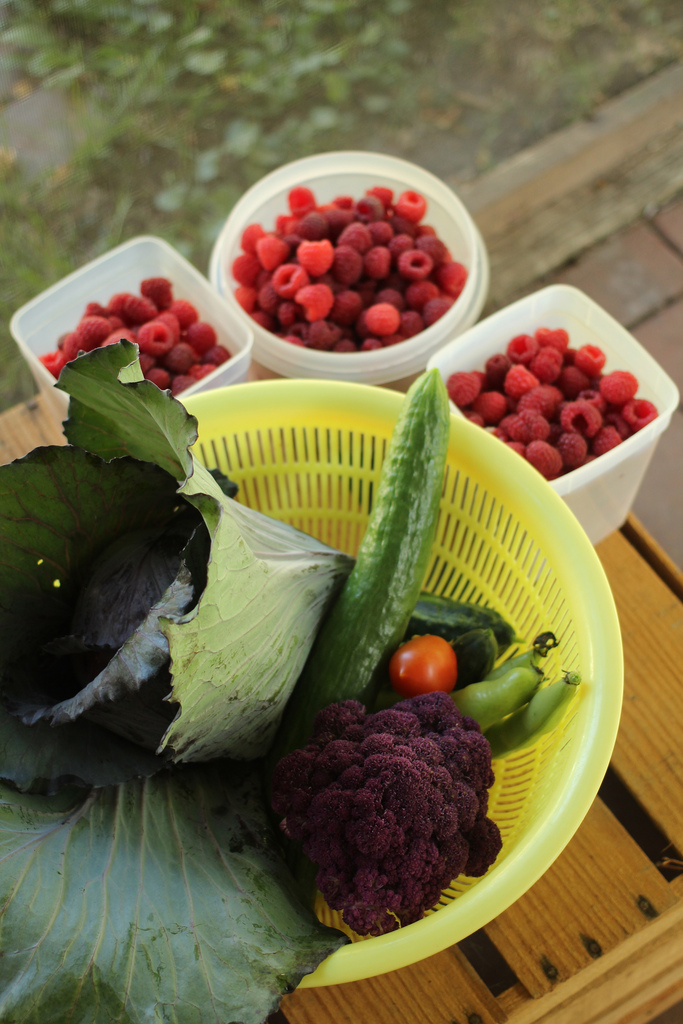 |
| the morning haul, epic raspberry year! |
These days, before the giant onslaught of produce arrives, are the most enjoyable. I buzz around the gardens every day, tweaking and observing. Much like the wasps cruising my broccoli patch, I am watching for signs of damage (they know how to spot the cabbage worms just like I do); for vines that need redirection or twine; for a hiding zucchini or cucumber.
And while I'm so very grateful: for good weather, a wonderful collaborator, and for having the available time and resources to do it: this year I'm also remembering to appreciate myself :)
grass (a rant)
I'm actually not in a ranty mood this morning, so perhaps I won't be too grouchy afterall. |
| bare feet in October! |
Just a heads up on a lawn care issue: Our neighbors use a lawn service (sigh) which sold them on a new, safer product a year or so ago. It was low toxic ("I don't even have to wear gloves!" said the employee--yegads!) and better for pets and the environment, they said. Turns out, Imprelis is a tree killer, specifically pines and spruce. Our neighbor lost a 40 foot tall tree, which acts as a privacy and noise buffer for them and somewhat for us. Thankfully their other pines seem okay for now. A coworker of D lost a tree as well. Talking to the lawn service, who said they only used it on 10% of their clients, THOUSANDS of trees in our area alone were affected. Per DuPont's "fact sheet" the damage is spread across Minnesota, Michigan, Indiana, Ohio, Pennsylvania, New Jersey and Wisconsin. (Note, if you find the the carefully worded info provided by the manufacturer scary, there may be a problem...)
Thank goodness this product was only approved for professional use, imagine if it was on the shelves of Walmart. Imprelis was "voluntarily" pulled from the market this summer, and a large claims process is proceeding. (Another note: my neighbors were offered 3 years of free service as part of their reimbursement over the issue...SIGH.) And of course, I have to ask myself if they didn't know it had the effect of killing pine trees, what other affects did the chemicals have (on wildlife, or edible plants)?
But this isn't the end of the story. Grass clippings from yards with Imprelis, per the label, are not to be composted. Mulch from the killed trees, per their website, is not to be used for landscaping purposes as well. (Firewood is okay). So where are all of these thousands of trees going? For trees reported to the company, there is a protocal being created for disposal. Many homeowners may not even know the cause of their tree loss, and send those pines to the municipalities for mulching, or have them shredded by the tree service. And if not, thousands of these trees are going into landfills.
It's a pickle, and we are concerned about using our free city compost and mulch next year. What to do? Free mulch is a mainstay of my garden paths, and I use it in ornamental gardens as well. There's no guarantee where purchased mulch comes from, either. I suppose we can try to find a known source--a tree taken down for other purposes, perhaps? I'll definitely be making my own leaf mulch this year too. As for the compost, I know people bring their grass clippings to our dropoff sites, and I'm sure at least some of them are from treated lawns. In the past, I've weighed the benefits of the program against the relative risks: Recycling yard waste and keeping it out of the landfill is a great service, and the input of chemicals along with all the leaves and compostables seems pretty small, but STILL.
One final afterword: I am also grateful that our state has a pesticide notification registry. Lawn care services are required to give a days notice before applying herbicides or pesticides. I can keep my hens in, and not hang up laundry on the days they are spraying. It's not a great solution, but I do appreciate it. Also--when I ratted on the lawn service last week (new employee, didn't call ahead, and was snarky to me when I asked him about it), I had an awesome conversation with my representative from the Department of Ag: she was well aware of all the nuanced issues involving the Imprelis recall, and gave me a sense that they were on top of the issue. See, government regulation, and State employees, a GOOD thing!
I did feel a bit guilty calling to complain, but then again--who is holding these services accountable if not us? While I don't fault these guys for trying to make a living, I do beleive they should have to follow the rules at all times. I have a BIG problem with a business that exists to poison the soil, all for the vanity of a perfect lawn. I feel like they prey on the insecurities of new homeowners to conform to an unrealistic idea of the carpet-like lawn. I do try to not give my neighbors a hard time (though I'm pretty sure they know how we feel by now). I do try to live a good example, and hand out organic produce and fresh eggs. And I don't apologize for my weedy lawn.


