Showing posts with label recordkeeping. Show all posts
Showing posts with label recordkeeping. Show all posts
Fall garden cleanup pep talk
This is the lecture I've been giving myself the past week, and I figured I'm not the only one who needs it:
BUT
It is also okay to string a pet plant along, if you're inclined. If you have a full fridge and can't deal with processing the last picking of green beans, or if the forecast has a rogue hot spell after one cold night and you think you might get a few more jalapenos, go for it. Cover plants with remay, sheets, or tarps, and most things can survive the first couple of light frosts. My summer squash is miraculously healthy and plugging away at fruit (and I'm not tired of them yet!) and I think I"ll let that baby drag on until the final freeze.

Don't try to do everything at once. Just like in the spring, tackle a section or two at a time. I picked most of the remaining harvest last week, and tackled the aformentioned tomato vines; this afternoon I'm working on peppers and beans. Prioritize by what is the least cold hardy (BASIL) and what can stay standing long into winter (kale, broccoli, leeks).
BUT
Don't leave everything until next spring either! Leaving mildewy or diseased plants over the winter is just creating issues for the following season. Non-beneficial insects will overwinter there as well. Besides, cleanup and preparation makes getting started in the spring SO MUCH easier. Everybody hates weeding, especially with the rationale that the coming freeze will kill plants anyway, but a last pass in your gardens and paths will really pay dividends later on.

It's okay to not compost everything. Our city collects yard waste, and while I try and recycle most of my weeds and garden byproducts within my own property, some things just aren't worth it (for me). I send sickly tomato and potato vines to the curb for pickup, as well as woody stems and root balls that will have a hard time breaking down. This reduces the time it takes my compost to be ready to use, and also cuts back on introducing disease or weeds. While definitely having volunteers like dill or celery is the norm in my garden, unfriendlies such as stinging nettle are not welcome. Even plants I like that are aggressive (cleome!) will often get send to the city, whose composting volume is large and hot enough that they do a better job of killing seeds and fully composting woody stuff.
If you don't have this option but you have the space you might want to separate out the more difficult waste products and give them their own pile. As woodier bits break down you can introduce them to a future turn of the compost.
Speaking of which, fall is a great time to turn that big pile of compost. I mostly feed my beds in the fall. One reason for me is that I have chicken manure going into my bins, and depending on the timing or my skill at building a great compost pile--this may not be broken down thoroughly when it goes into my garden. Too-fresh manure can burn plants, and has the potential to transmit pathogens. While I don't have a lot of worries about catching anything nasty from my girls, the generally accepted practice is to wait 90 days after spreading fresh manure before harvesting (longer if the food is in contact with the soil). So for us Northern gardeners, this works out well for feeding beds in the fall anyway. If my compost isn't fully finished, a last sit in the garden over the winter helps break the remainder down, all the while sending nutrients into the soil below.
Putting gardens to bed: The last fall task for me is mulching with leaves and grass clippings. The final mows of the season are great for creating a lovely brown/green mix of mulch that can cover sleeping gardens and feed them all winter long, as well as protecting the soil from harsh conditions. If you're a planner and know where your earliest crops will be next season (onions, lettuces, peas etc) you can prep those beds thoroughly now, so they are ready to plant as soon as the ground is warm enough. No digging required, I often plant my onions right through the mulch. Actually the first planting will be this fall's garlic: so I clean up and feed that bed first so I can plant around Halloween, and mulch it super well with leaves/grass (and straw, if I have it).
Makes notes for next year. I definitely struggle with this,but it's the perfect time to reflect on what worked and what didn't, and what your goals are for next season. I think the hardest part of this is the natural let-down of the end of the season. As I work in my overgrown and weedy beds, I tend to only see the failures (how did I make so little pesto this year? Why were my peppers so non-prolific?) but sitting down with your spring notes/plans can help you gain a little perspective and remind you of what did work (what a great year for cauliflower, I had almost forgotten).
While most of this week I have just wished for it all to be done already, making plans to spend the last brisk sunny days putting my garden to bed for the winter is not the worse chore I can imagine. I can't wait to see the (mostly) neat beds ready to sleep away until spring.
I remember last spring, when our magnolia bloomed early, that it was not really an entire month ahead, it was just that two weeks early, combined with the late spring of the previous year, made it seem extraordinary. And so this year the pendulum swings back.
If I hear one more person say (at the grocery store, at the bank teller) how it was EIGHTY degrees last year, as if that is the way it is supposed to be, I may have to throttle them, or at least gently remind them of our loss of fruit crops, and of drought. But I don't, as I too am wishing for some warmer days--though really, a rogue 55 degrees for a few hours would be fine. Above freezing for two days in a row? Okay I'll take that.

Last year's heat wave was freaky, and I had a growing sense of dread as it continued day after day. But then again, it's really hard not to enjoy sunshine and coatless temperatures. This cold streak is a little harder to bear, but it helps to commiserate with internet friends who are even colder, or who have a foot of snow! It's also nice to have the perspective from looking at my notes from year to year.
I knew last March that having the first year of winter gardening in the hoop house occur in such a non-winter would make it a little harder to apply the lessons I learned. I started a ton of flats (mostly alliums) with the thought that I could move them outside by now, but that's just not the case. My early greens are hardened off, but I even pulled them inside since our lows are below 10 degrees this week. (It would also probably help if my cold frame wasn't frozen to the ground--I normally move it close to the house and use it to extend my light space on sunny days, and this year I can't even get the lid open.)
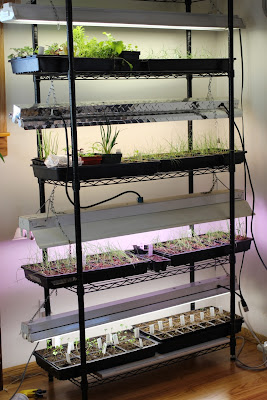
Oh well, I scrounged up extra lights from the basement, and have doubled my space inside, and will just try and hold on for another week or two!
And thank goodness the sun is out, there's always a heat wave in the hoop. I will head up the hill and spend some quality time soaking in some vitamin D in my wee Florida simulator.
 |
| On the first day of spring, a whole flock of robins showed up in the backyard, just to cheer me up. |
If I hear one more person say (at the grocery store, at the bank teller) how it was EIGHTY degrees last year, as if that is the way it is supposed to be, I may have to throttle them, or at least gently remind them of our loss of fruit crops, and of drought. But I don't, as I too am wishing for some warmer days--though really, a rogue 55 degrees for a few hours would be fine. Above freezing for two days in a row? Okay I'll take that.

Last year's heat wave was freaky, and I had a growing sense of dread as it continued day after day. But then again, it's really hard not to enjoy sunshine and coatless temperatures. This cold streak is a little harder to bear, but it helps to commiserate with internet friends who are even colder, or who have a foot of snow! It's also nice to have the perspective from looking at my notes from year to year.
I knew last March that having the first year of winter gardening in the hoop house occur in such a non-winter would make it a little harder to apply the lessons I learned. I started a ton of flats (mostly alliums) with the thought that I could move them outside by now, but that's just not the case. My early greens are hardened off, but I even pulled them inside since our lows are below 10 degrees this week. (It would also probably help if my cold frame wasn't frozen to the ground--I normally move it close to the house and use it to extend my light space on sunny days, and this year I can't even get the lid open.)

Oh well, I scrounged up extra lights from the basement, and have doubled my space inside, and will just try and hold on for another week or two!
 |
And thank goodness the sun is out, there's always a heat wave in the hoop. I will head up the hill and spend some quality time soaking in some vitamin D in my wee Florida simulator.
Early spring hoopdate - March edition
It doesn't feel like early spring: our forecast is in the 70s for the next week. While I had resigned myself to a non-wintery winter, this is getting a little unnerving. I was re-reading last year's garden notes, in mid-March I was excited for days in the 50s, and we hit a very cold stretch in April. So we'll see how it goes.


With a forecast of clouds on Sunday, I was set to plant: but almost changed my mind when it turned sunny and the hoop shot to 100 degrees. I opened up the doors and went ahead, giving everything a good drink to minimize stress. The hoop-raised plants are pretty used to extremes, and as of yesterday they looked fine and happy in their new homes. I also planted a couple of experimental rows of peas.
 |
| wee baby mache, larger than life size. |
 |
I looked back at my notes from last year (see a pattern here?) and growth-wise, the hoop house plants are doing a little better than last year's low tunnels, and that may just be due to the warm winter we had. Seed-wise, it seems last year's schedule--I started spring seeding in early- to mid-march--is about right. So, except for harvest access, (and of course, the added value of hanging out in some sunshine on a winter's day!) it seems to me that low tunnels are equally as effective at winter gardening endeavors.
I do love my big hoop (I think I've said that out loud about six times this weekend) but it's nice to know that simpler and smaller alternatives can work just as well.


