Showing posts with label seed starting. Show all posts
Showing posts with label seed starting. Show all posts
0-2 weeks to last frost(!) - Some tips on early spring planting
As is fairly normal for this time of year, we've had a rollercoaster of weather the past two weeks. When the temperature dropped into the forties with rain, most of my plants came back inside for an extended break, and I bunkered up as well.

Inside the hoop house, spring plants loved it though. They didn't get the rain, but the cool, grey days were perfect for spinach, salad greens and peas. This week I had to start adding support to the indoor peas, while their outdoor counterparts are all of an inch high.

But the pendulum swung back the other way this week, we're at nearly 70 degrees as I write. I semi-opened up the hoop this week--rolled up the sides and took out a few side panels that were getting in the way of my snap peas. For the most part, the plants inside now are tolerant to light frosts, and are less happy when the temperature climbs to 100+ degrees. Also, with the sides up I can install my gutters and take advantage of that rain!
Last week I was talking to a woman who works with local farmers, and she was saying that the window of opportunity for spring planting was frustratingly small this year. We'd have a couple of nice days, then lots of rain, and they couldn't get their tractors into the fields. It made me realize that home gardeners have an advantage for sneaking in early crops. Still, dealing with wet soil can be an issue. I have a couple of tricks:
1. Prep beds in the fall. I turn my compost piles in the fall, and give all available beds a nice layer of compost and a mulch of leaves. For beds that will have bedding plants, I don't have to do anything in the spring--just move some mulch out of the way, and plant. This is great for broccoli/cabbage and onions, who are often ready to plant when the weather is wetter. One note, I am observing some slug issues with the leaf-mulched beds where I did this, they apparently can also be cozy spots for critters to overwinter.

2. The 2-step turnover. I know the latest trend is minimal working of soil--a lot of folks go the no-till route, and some say not even to turn compost into the soil at all, just let the worms do the work. I've never had or used a tiller, but I do like to dig a bit in my garden. Sometimes I have late fall plantings that don't get fed before winter--I'll have a pile of compost on the side of a bed that needs distributing. And also, I confess, turning over soil with a shovel is a distinct pleasure for me. I love the physicality of the process, and the sight of bits of eggshells and mysterious half-composted bits, fat worms and thousand-legged bugs. I love how the robin follows me around, snatching treats when I turn my attention elsewhere for a minute. So despite the slight risk of bringing weed seeds to the surface, I still do a bit of shovel work.

3. The cheat. When I want to plant tiny, fine seeds (such as lettuce or carrots), or the ground is just too wet to work, I spread a little potting soil. In this spot, I had beds prepped for beans, but wanted to add a few rows of lettuce and arugula around the outside. I pulled back the mulch, and spread some leftover soil mix. In this case I recycled some empty (i.e. failed) pots from my seed starting extravaganza.

This works great for folks who use lasagna-style gardening, and have heavily mulched beds. It just gives the seeds a nice layer of fine soil to sprout in. It's also not likely to have weed seeds, which gives more delicate plants a nice head start. (Ahem, in my hoop house I spread some lovely fine sifted compost before planting carrots, and ended up with a cover crop of lambs-quarters, darnit!)
So here we go! There are currently no days below 44 in the Madison 7-day forecast, and I'm getting pretty optimistic that we are past a danger of a hard frost. I'm still waiting on planting my heat-loving peppers, eggplants, and tomatoes, and am holding off on cucumbers and melons. But, I did seed some beans yesterday, and my zucchinis as well. My fruit trees are getting ready to bloom, the grapes are breaking bud, and all the birds are telling me spring is here!
Four weeks to last frost, and a follow up
As did many in Wisconsin (and apparently many places in the US) we had snow this week, blarg! Even worse was waking up to a 19 degree morning, with a high of 37, which is the normal low temperature for this time of year. But really, somehow, in about 4 weeks our chances of frost will be nearly over. Right? RIGHT?
There is not too much on the indoor seeding front for me at this stage. I started a few more flowers: nasturtiums, marigolds, and some cosmos and zinnias. You can start a few last vegetables at this point, such as cucumbers or squash, but I usually find these all do better seeded directly in the ground, and don't seem worth the effort of babysitting inside. If you do want to get a jump start on these guys, I would use compostable pots or newspaper for seeding, so these can go directly into the ground with less transplant shock.
There are a couple of good indoor chores this time of year:
Plant Inventories: Make a list of what you've started and tick off those healthy seedlings. This is where I discover my Ancho peppers did not germinate at ALL, and that I planted way too many Sungold tomatoes (again). Make notes if you have to pick up any plants that failed, or better yet trade emails with a gardener friend and swap! (Anybody have any Ancho peppers??)
Pot up: If the season is running cold (like it is) I will pot up tomatoes at this stage so they can wait a bit more happily for warm planting weather. Select your favorite strong seedlings, and plant them deeply in a larger pot. Burying the bottom of the stem makes them even sturdier and roots will grow right out of the stem too.
Fertilize: I am not a huge proponent of fertilizing, I generally rely on my overall soil health and add a ton of compost to my garden beds and leave it at that. But, I do have a small bag of organic fertilizer I use for container plantings and at this time of year. Fertilizing too early seems to make seedlings leggy and overgrown, but this late in the stage they can sometimes get a boost from a light feeding a few weeks before being planted out. I mix in some granulated fertilizer (or compost) when I pot up tomatoes, or make a compost tea (or just dissolve a little organic fertilizer) for watering.
But, the best part of this stage of pre-frost preparation is getting out in your real outdoor garden (no lights, no flats, phew!). I seeded peas a week or so ago, and this is a fine time to sow some early lettuce or spinach if you have a dry bed ready to plant. This weekend I'm transplanting onions. Since I had mentioned my method way back in February, I thought I'd follow up with a few pictures of those seedlings.
 |
| Look, no snow! And a chicken! Here are the flats, a nice healthy size for planting. |
 | ||||||||
| Popped out of the cell pack, you can see all the roots. |
 | |||||||
6 weeks to last frost: Gardeners, start your tomatoes!
Sorry I'm a little late on this one, but then again, so is the weather! We've had a crazy week which included some good news, some bad news, and these little guys, which are pretty distracting.

 |
| Sturdy Roma tomato: this is one of a few I started early to go in the hoop house. Confession: I also started my basil early. |
I don't have a ton to add about starting sets at this point, except to mention that if you have been seeding all along, this is the stage where you have the most work cut out for you. Learn from me: don't have 17 flats of plants to take care of(!!). But even with a few, you are watching the latest germinators, adjusting light heights, checking older plants for moisture levels, and maybe even hauling flats outside to get some real sun on some nice days (or if you have a cold frame or hoop, most days). But it's also the stage where you start to see the rewards of all that labor. Look at those sturdy plants! You can almost imagine your future garden beds filled with all these babies you started yourself.
 |
| Look at all those peppers! |

8 weeks to frost - transplanting
Last week I seeded the brassicas: Broccoli, cabbage and cauliflower. These generally are advised to plant 6-8 weeks before setting out, but since most of these are fairly cold tolerant, that set-out date can be a little earlier than the average last frost. Depending on the forecast and how warm the soil is on a given year, I start thinking about setting cabbage and broccoli out in mid- to late-April, with the protection of row cover or a low tunnel. So I do start these on the early end of the range. Another good idea with these guys is staggering planting--start a few indoors early, seed a few outdoors later, and you'll extend your harvest.
On the schedule this week are the remaining peppers, and a few ornamental flowers. But, also on the agenda was transplanting some of my earlier starts:

But, if you need that plant (perhaps the cell next door had poor germination) or you just can't stand to kill an otherwise healthy seedling, here's how I transplant young plants. In my case, I have deliberately overseeded a few things to save some space under my lights during germination, and this week I was ready to move them into their future homes.

My tool of choice for this is a wooden skewer. I poke the blunt end under the chosen seedling, and gently lift until it is rising out of the pot with no resistance. Very gently, lift the plant by the stem, just under the leaves. If all goes well you'll have a barely disturbed baby root ball.


10 weeks to last frost (give or take) - how much to plant?

Depending on your variety and seed packet, eggplants and some hot peppers are sowed between 8-10 weeks. Last year these were slow starters for me, and although I have fresh seed for several of them I went ahead and started most of them on the early side of the range.
As these are heat-loving plants, and our house is at a chilly 60-something degrees, I wrestled my heat mat away from my home-brewing husband and put it under the flats to help with germination. As I'm cheap and only have one small mat, I stack flats, and rotate plants out as they sprout. Our bathroom is also for some reason the warmest room in the house (plus bonus humidity!) so I've used that in the past-- there are lots of other low-tech options for boosting heat.

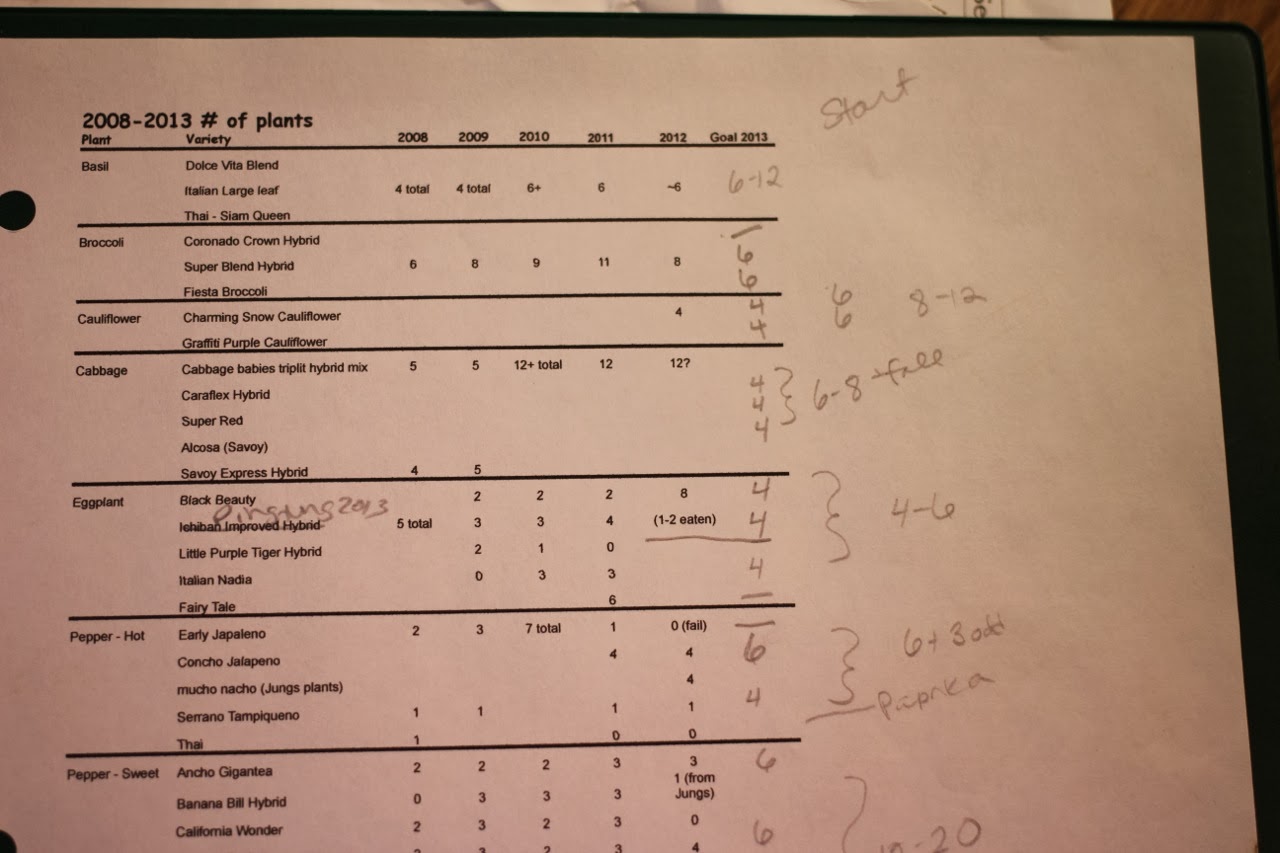
While it can be a little torturous to start thinking about preserving before your seeds have even sprouted, I find this is a good, realistic time of year to assess what you've been eating. At the beginning of winter, you are using up fresh stores, and possibly hoarding some of your more precious preserves. But by March, I think you have a better sense of what's left on your pantry shelves, and if those high summer ideas for meal plans are holding up in reality. Are you craving green vegetables on your plate, or are you happy with the starchy, rooty, carb-laden comfort foods of winter? Is your tomato shelf surprisingly full, or are you already skimping on opening jars of salsa?
So, back to the numbers game: how many seeds to start? My rule of thumb is 50-100% more than you want. For example, if I want 2 tomato plants of a specific variety, I start 3 or 4. That allows for a dud germination, plus a spare plant in case of calamity (death by frost/hail, or a being stepped on by a dog). I usually end up with a flat's worth of spare plants at the end of the planting season, but there are always friends/neighbors to share with, or a food pantry or community garden that would love to take them. It also lets you select the best/healthiest specimens to plant. If I have a notoriously poor germinator (for me, parsley) or older seeds, I will double-up on the seeding to make sure I have enough starts, you can always thin out your pots later.
And, just because it's freezing cold and snowy out, one last summertime photo to remind me what this is all about:

Seed Starting - Alliums
I used up my last storage onions last week. If I can't quite grow enough to last me until the next year's harvest (or chive season!), at least I can make it to the next year's sowing!I started growing onions from seed about 4 years ago. Previously I purchases bundles of plants from our local garden center, but decided I wanted the variety control and price savings of growing my own. Plus: they need starting 10-12 weeks before planting out, which satisfies my craving for growing, and keeps me occupied until I can start the fun crops later. Also, per my extension office*, onion sets (the little bulbs you see at groceries and seed stores in spring) are not as good to use:
Planting onion sets is not recommended for market-quality onions. Sets are the second year’s growth of storage varieties or multiplier onions and therefore tend to be less sweet than other onions. In addition, they may bolt or go to seed early.


Using three fingers as a "dibble", I poke 15 holes in each cell, and drop a seed or two in each. Allium seed does not keep well--especially hybrids--so if you are re-using last year's seeds it may pay to plant extra. You can always thin later. This year several of my (new) fedco packs were held over from last year, and they gave me extra, noting a 75% germination rate. So I double-seeded those quite a bit.
This is a little bit tedious, but three or four flats is a ton of onions (well--180 or so plants per flat!), and I can seed them all in less than an hour. If you were doing this commercially, it probably wouldn't be worth it, but at this scale I find it manageable. Onion sets can be $8-10 for 50-75 plants at our local garden center, and a seed pack (well more than a flat's worth) is less than $2! I label each flat with some masking tape, cover with a plastic lid or a bag to hold in moisture, and put them someplace relatively warm to germinate.
In around a week you'll start spotting seedlings, at which point move them under your lights.


Alliums don't like to dry out, so try and keep them evenly moist. I generally water from the bottom for these. After a few weeks you can feed with a mild organic fertilizer, or some compost tea.


There's some debate whether or not to trim plants to promote thicker stock. I've done it both ways. Mostly, I think trimming is useful if plants are getting leggy and tipping over, or they won't fit under the lights! Experiment a little and see what method you like. It definitely doesn't hurt to trim them. Our extension office recommends trimming to 5 inches at planting time, which encourages root establishment.
The reason I like this size flat insert is that when it comes time for planting, I just carefully tip one pack out at a time, and gently tease apart the plants--their roots will be intertwined but they are surprisingly cooperative to untangling. Individual plug cells were a total PITA to transplant (poking each cell from below with a pencil to get them out, arg!), and whole planted flats meant that I had to plant them all at once or have an awkward half-flat leftover.

*By the way, I've probably mentioned our University Extension office a lot in these last posts, they are an excellent resource. I find that publications aimed at market growers are super valuable for serious home gardeners, with a little adjustment for scale. There's an entire series of PDFs available for free on growing vegetables in Wisconsin, and much of what I've learned about Onions is from this one: http://learningstore.uwex.edu/assets/pdfs/A3785.PDF. They include information from seed starting through to harvest and storage, and are of course appropriate for Wisconsin climate/soil types.
12 weeks to last frost
I hesitate to start a post with a title like this--it suggests I'll have a series. It could happen!? In fact, I've already split this into two posts, so I could start with a general overview of seed starting.
In Madison, our average last spring frost occurs right around mid-May. Frost dates are funny little statistics. I found a good map of Wisconsin climate data here, at our extension office. If you want to get all weather-nerdy (as I do) you can find charts with the percentage chances by date. For instance, after May 10th, there is a 50% chance of frost, and after the 27th, there is a 97% chance we will not have below freezing weather. Cool, right?
If you're not in Wisconsin, you can do a quick google search for your frost dates by zip code, but check a few sources, I found a lots of variations between commercial sites. Look for USDA data, and compare it to your own observations about your local micro-climate. My little protected south-facing yard warms up pretty fast, so I tend to trust the slightly earlier dates. If you've gardened for a while, look back at your notes from previous years. Last year? We had frost right up to May 12th, and the way things are going I think this spring will be a slow start too.

So, a few very basic overview details on starting your own seeds--I'll be more specific in later posts. I use a very basic setup: traditional flats and cell inserts (plastic), and a purchased seed starting media. If your preference is homemade mix and soil blocks, even better. Use what you like!

I also wash, reuse and re-purpose miscellaneous pots for many years. There is some concern regarding transmitting disease but I have not yet had a problem.
My light setup is a utility shelf with regular shop lights stolen from the basement where they are used the rest of the year. I try to have one warm and one cool bulb in each fixture, and am slowly investing in gro-lux bulbs (one for each). Once sprouted, I have flats as close to the light as possible, and I rotate around as needed to keep similar sized seedlings together. With a simple 2-bulb fixture, I do end up rotating things a bit for even growth. Some might find this tedious but for me, spring sets are all about puttering.


Just a last note: this is my setup which has evolved over 10-15 years--it started out WAY smaller--one or two lights, a few flats, and lots of practice. I find it fun, I know not everybody has the time or space (or inclination), and buying sets is a perfectly fine option. But if you are yearning to have something green indoors to remind you that spring is indeed coming: don't worry about having the perfect equipment to start with, and go for it!
I remember last spring, when our magnolia bloomed early, that it was not really an entire month ahead, it was just that two weeks early, combined with the late spring of the previous year, made it seem extraordinary. And so this year the pendulum swings back.
If I hear one more person say (at the grocery store, at the bank teller) how it was EIGHTY degrees last year, as if that is the way it is supposed to be, I may have to throttle them, or at least gently remind them of our loss of fruit crops, and of drought. But I don't, as I too am wishing for some warmer days--though really, a rogue 55 degrees for a few hours would be fine. Above freezing for two days in a row? Okay I'll take that.

Last year's heat wave was freaky, and I had a growing sense of dread as it continued day after day. But then again, it's really hard not to enjoy sunshine and coatless temperatures. This cold streak is a little harder to bear, but it helps to commiserate with internet friends who are even colder, or who have a foot of snow! It's also nice to have the perspective from looking at my notes from year to year.
I knew last March that having the first year of winter gardening in the hoop house occur in such a non-winter would make it a little harder to apply the lessons I learned. I started a ton of flats (mostly alliums) with the thought that I could move them outside by now, but that's just not the case. My early greens are hardened off, but I even pulled them inside since our lows are below 10 degrees this week. (It would also probably help if my cold frame wasn't frozen to the ground--I normally move it close to the house and use it to extend my light space on sunny days, and this year I can't even get the lid open.)
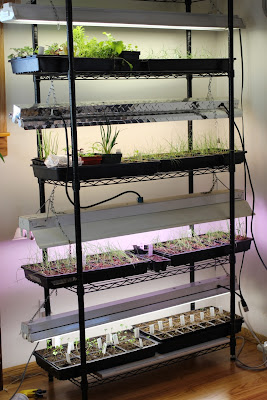
Oh well, I scrounged up extra lights from the basement, and have doubled my space inside, and will just try and hold on for another week or two!
And thank goodness the sun is out, there's always a heat wave in the hoop. I will head up the hill and spend some quality time soaking in some vitamin D in my wee Florida simulator.
 |
| On the first day of spring, a whole flock of robins showed up in the backyard, just to cheer me up. |
If I hear one more person say (at the grocery store, at the bank teller) how it was EIGHTY degrees last year, as if that is the way it is supposed to be, I may have to throttle them, or at least gently remind them of our loss of fruit crops, and of drought. But I don't, as I too am wishing for some warmer days--though really, a rogue 55 degrees for a few hours would be fine. Above freezing for two days in a row? Okay I'll take that.

Last year's heat wave was freaky, and I had a growing sense of dread as it continued day after day. But then again, it's really hard not to enjoy sunshine and coatless temperatures. This cold streak is a little harder to bear, but it helps to commiserate with internet friends who are even colder, or who have a foot of snow! It's also nice to have the perspective from looking at my notes from year to year.
I knew last March that having the first year of winter gardening in the hoop house occur in such a non-winter would make it a little harder to apply the lessons I learned. I started a ton of flats (mostly alliums) with the thought that I could move them outside by now, but that's just not the case. My early greens are hardened off, but I even pulled them inside since our lows are below 10 degrees this week. (It would also probably help if my cold frame wasn't frozen to the ground--I normally move it close to the house and use it to extend my light space on sunny days, and this year I can't even get the lid open.)

Oh well, I scrounged up extra lights from the basement, and have doubled my space inside, and will just try and hold on for another week or two!
 |
And thank goodness the sun is out, there's always a heat wave in the hoop. I will head up the hill and spend some quality time soaking in some vitamin D in my wee Florida simulator.
Early spring hoopdate - March edition
It doesn't feel like early spring: our forecast is in the 70s for the next week. While I had resigned myself to a non-wintery winter, this is getting a little unnerving. I was re-reading last year's garden notes, in mid-March I was excited for days in the 50s, and we hit a very cold stretch in April. So we'll see how it goes.


With a forecast of clouds on Sunday, I was set to plant: but almost changed my mind when it turned sunny and the hoop shot to 100 degrees. I opened up the doors and went ahead, giving everything a good drink to minimize stress. The hoop-raised plants are pretty used to extremes, and as of yesterday they looked fine and happy in their new homes. I also planted a couple of experimental rows of peas.
 |
| wee baby mache, larger than life size. |
 |
I looked back at my notes from last year (see a pattern here?) and growth-wise, the hoop house plants are doing a little better than last year's low tunnels, and that may just be due to the warm winter we had. Seed-wise, it seems last year's schedule--I started spring seeding in early- to mid-march--is about right. So, except for harvest access, (and of course, the added value of hanging out in some sunshine on a winter's day!) it seems to me that low tunnels are equally as effective at winter gardening endeavors.
I do love my big hoop (I think I've said that out loud about six times this weekend) but it's nice to know that simpler and smaller alternatives can work just as well.


